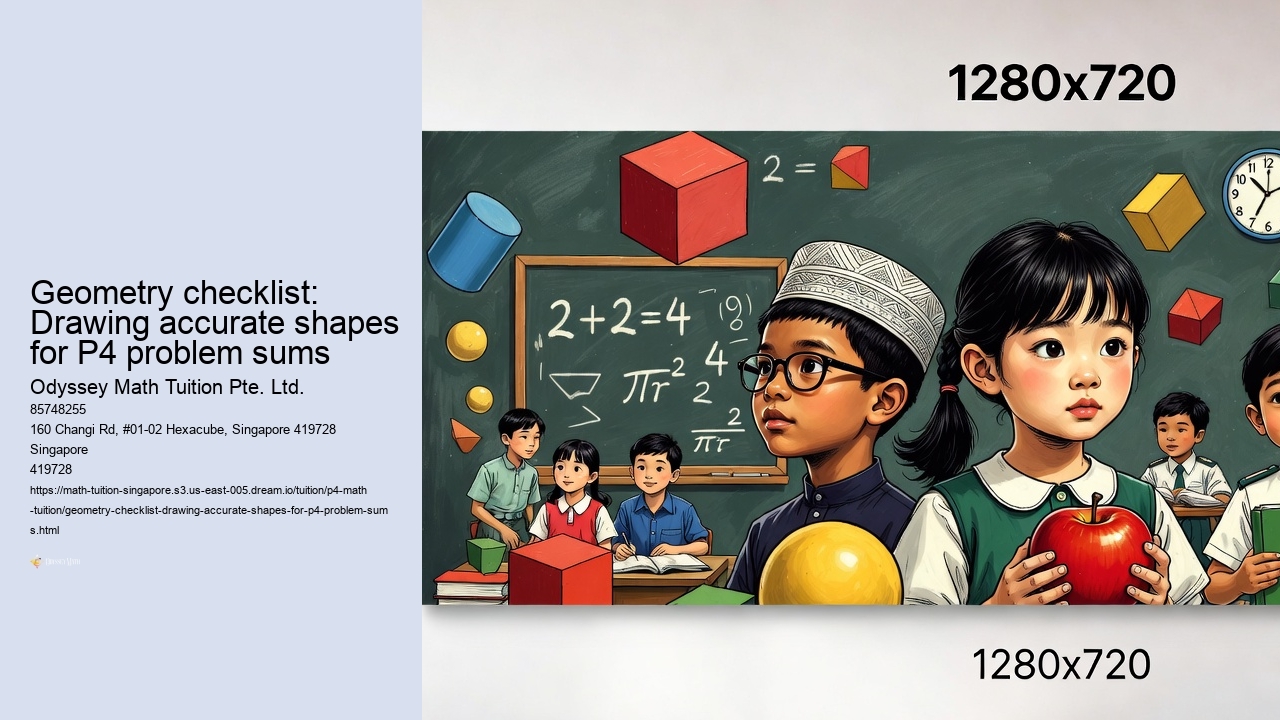
Geometry checklist: Drawing accurate shapes for P4 problem sums
P4 Math Worries? Geometry Can Be Fun!
Geometry Checklist: Drawing Accurate Shapes for P4 Problem Sums
Singaporean parents, kiasu or not, we all share the same hope: to see our children thrive. Geometry checklist: Ensuring accurate measurements in P4 diagrams . In today's fast-paced educational scene, many parents in Singapore are hunting for effective methods to improve their children's comprehension of mathematical principles, from basic arithmetic to advanced problem-solving. Establishing a strong foundation early on can substantially elevate confidence and academic performance, assisting students conquer school exams and real-world applications with ease. For those considering options like p4 math tuition it's crucial to concentrate on programs that highlight personalized learning and experienced guidance. This method not only tackles individual weaknesses but also cultivates a love for the subject, resulting to long-term success in STEM-related fields and beyond.. And in Singapore, that often starts with a strong foundation in… you guessed it, Mathematics! In Singapore's rigorous education structure, parents fulfill a vital part in directing their kids through significant tests that form educational paths, from the Primary School Leaving Examination (PSLE) which tests fundamental abilities in subjects like mathematics and STEM fields, to the GCE O-Level exams focusing on intermediate proficiency in diverse subjects. As learners move forward, the GCE A-Level examinations necessitate deeper logical skills and subject mastery, commonly determining higher education placements and career trajectories. To keep knowledgeable on all aspects of these national evaluations, parents should check out authorized resources on sec 1 exams papers provided by the Singapore Examinations and Assessment Board (SEAB). This guarantees access to the latest syllabi, examination schedules, registration information, and guidelines that correspond with Ministry of Education requirements. Consistently referring to SEAB can aid households plan successfully, minimize ambiguities, and support their offspring in achieving peak results during the demanding landscape.. Primary 4. That's when things start to get real, right? The PSLE prep pressure cooker is slowly heating up, and the syllabus throws curveballs like… Geometry! Don't panic, lah! While the word itself might sound intimidating, especially when you are looking at p4 math tuition, geometry can be surprisingly engaging, even… dare I say… fun!
P4 Math Geometry Fundamentals
So, what exactly are we talking about when we say "geometry" in the context of P4 math? It's all about understanding shapes, their properties, and how they relate to each other. The Singapore MOE syllabus focuses on building a solid foundation. This includes:
Basic Shapes: Identifying and drawing squares, rectangles, triangles, circles, and even 3D shapes like cubes and cuboids.
Properties of Shapes: Understanding the characteristics of each shape – number of sides, angles (right angles, acute angles, obtuse angles), parallel lines, perpendicular lines, and symmetry.
Area and Perimeter: Calculating the area and perimeter of squares and rectangles. This is where accurate drawing becomes super important!
Angles: Measuring angles using a protractor and understanding the concept of degrees.
Geometry in Problem Sums: Applying geometric concepts to solve word problems, often involving real-life scenarios.
Why is this important, leh? Because a strong grasp of geometry in P4 lays the groundwork for more complex topics in upper primary and beyond. Think about it: trigonometry in secondary school, calculus in JC… it all builds on these foundational concepts. Plus, visualising and drawing shapes accurately helps develop spatial reasoning skills, which are crucial for problem-solving in general. And with the rise of AI, spatial reasoning will be even more critical. Math underpins AI, machine learning, and data analysis, giving your child an edge in an AI-driven world.
Fun fact: Did you know that the ancient Egyptians used geometry extensively to survey land and build the pyramids? Talk about practical applications!
The Power of Accurate Drawings in P4 Math
Let's be honest: in P4 math, especially when tackling those tricky problem sums, a picture is worth a thousand words (and maybe a few extra marks!). Accurate drawings are not just about aesthetics; they are a powerful tool for:
Visualising the Problem: A well-drawn diagram helps your child understand the problem better by providing a visual representation of the information given. This is especially helpful for word problems that involve spatial relationships.
Identifying Key Information: By drawing the shapes and labeling the relevant dimensions, your child can easily identify the key information needed to solve the problem.
Developing Problem-Solving Strategies: The act of drawing can often spark insights and help your child develop effective problem-solving strategies. For example, drawing a rectangle and dividing it into smaller squares can help visualise fractions and ratios.
Avoiding Careless Mistakes: Accurate drawings can help prevent careless mistakes by ensuring that your child understands the relationships between different parts of the problem.
Think of it this way: if a problem sum asks about the area of a rectangular garden, a quick, accurate sketch can immediately clarify the length and breadth, preventing confusion and ensuring the correct formula is applied. In the demanding world of Singapore's education system, parents are progressively concentrated on arming their children with the skills needed to thrive in challenging math syllabi, encompassing PSLE, O-Level, and A-Level preparations. Recognizing early signs of difficulty in areas like algebra, geometry, or calculus can bring a world of difference in fostering tenacity and proficiency over complex problem-solving. Exploring dependable singapore maths tuition options can provide tailored support that corresponds with the national syllabus, making sure students obtain the boost they want for top exam scores. By focusing on engaging sessions and steady practice, families can assist their kids not only achieve but exceed academic expectations, paving the way for prospective chances in high-stakes fields.. This is especially important as your child progresses towards PSLE math tuition.
Interesting fact: Many famous mathematicians, like Leonardo da Vinci, were also skilled artists. They understood the importance of visual representation in understanding mathematical concepts.
Geometry Checklist for P4 Success
Okay, so how do we ensure our P4 kids are drawing accurate shapes and conquering those geometry problem sums? Here's a handy checklist:
Use the Right Tools: Invest in a good quality ruler, protractor, and compass. These are essential for drawing accurate lines, angles, and circles.
Practice Regularly: Like any skill, drawing accurate shapes requires practice. Encourage your child to practice drawing different shapes regularly, even if they are not part of a specific problem sum.
Pay Attention to Detail: Emphasise the importance of paying attention to detail when drawing shapes. This includes ensuring that lines are straight, angles are accurate, and dimensions are correctly labeled.
Label Everything Clearly: Encourage your child to label all the relevant dimensions and angles on their drawings. This will help them keep track of the information and avoid mistakes.
Check Your Work: Always encourage your child to check their drawings to ensure that they are accurate. This includes measuring angles, checking that lines are parallel or perpendicular, and verifying that the dimensions are correct.
Relate to Real Life: Connect geometry to real-life examples. Point out shapes in everyday objects and discuss their properties. This will make learning more engaging and relevant.
And remember, don't stress if your child struggles at first. Geometry can be challenging, but with consistent practice and the right guidance, they can definitely master it. If you find your child needs extra support, consider exploring p4 math tuition options. A good tutor can provide personalised instruction and help your child build confidence in their geometry skills.
Level Up with Geometry: Connecting to Future Success
It's easy to see P4 math as just… P4 math. But the truth is, these foundational skills have a HUGE impact on your child's future academic and career prospects. A strong foundation in math, especially geometry, opens doors to:
Top Academic Streams: Solid math skills are crucial for getting into the top streams in secondary school and junior college.
Prestigious Schools: Competition for places in top schools is fierce, and strong math scores can give your child a significant advantage.
Competitive University Courses: Many of the most sought-after university courses, such as engineering, data science, medicine, and finance, require a strong background in math.
High-Demand Jobs: In Singapore's merit-based economy, math skills are highly valued by employers. Many of the fastest-growing and highest-paying jobs require a strong understanding of math and data analysis.
Moreover, let's not forget the impact of AI. Math underpins AI, machine learning, and data analysis. By building a strong foundation in math now, you are equipping your child with the skills they need to thrive in an AI-driven world. Whether it's becoming a data scientist, a software engineer, or even an entrepreneur, strong math skills will give your child a significant edge.
So, jia you! Embrace geometry, encourage accurate drawings, and remember that every little bit of progress counts. With a little effort and the right support, your child can conquer P4 math and build a bright future. And if you need a little extra help, don't hesitate to explore PSLE math tuition, O-Level math help, or even a JC H2 math tutor down the road. The key is to start building that solid foundation now!
Why is drawing accurate shapes important in P4 Geometry problem sums?
Accurate shapes help visualise the problem, making it easier to understand and solve, especially when dealing with area, perimeter, and other spatial relationships.
What tools can my child use to draw accurate shapes?
A ruler, protractor, set square, and compass are essential tools for drawing accurate lines, angles, and circles. Ensure your child knows how to use them properly.
How can I help my child improve their shape-drawing skills?
Practice regularly with different types of shapes. Start with simple shapes like squares and rectangles, then move on to more complex ones like triangles and circles. Use worksheets or online resources for practice.
What are some common mistakes to avoid when drawing shapes?
Avoid freehand drawing when accuracy is needed. Double-check measurements and angles. Ensure lines are straight and meet at the correct points.
How does drawing shapes help with problem-solving?
Drawing shapes provides a visual representation of the problem, allowing children to identify relationships between different parts and apply the correct formulas or strategies.
What if my child struggles with using a protractor or compass?
Seek help from their teacher or a tutor. There are also many online tutorials and videos that can provide step-by-step instructions. Practice is key!
Are there any shortcuts for drawing shapes quickly during exams?
While accuracy is crucial, learning to sketch shapes quickly can save time. Focus on getting the proportions right, even if the lines arent perfectly straight.
How can I assess my childs shape-drawing skills?
Give them practice problems that require drawing shapes and check their accuracy. Look for common errors and provide targeted feedback.
What resources can I use to find geometry problem sums that require drawing shapes?
Assessment books, past year exam papers, and online educational platforms often include geometry problem sums. Look for questions involving area, perimeter, and angles.